


White Composite Fillings
We Offer Metal-Free Restorations
If you want the option of modern, state-of-the-art white composite fillings that are natural looking, contain no metals, and can actually strengthen your teeth, give us a call today!

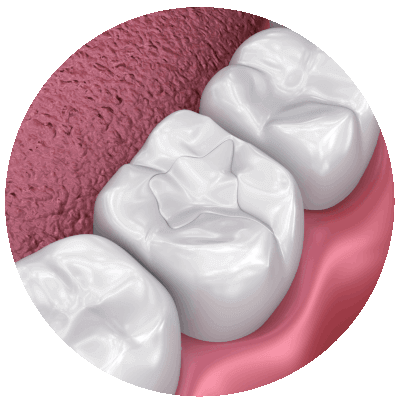
Replace Metal Fillings With
Mercury Free
Tooth-Colored Composite Fillings
Silver amalgam was the standard filling material used in dental practices for years. While amalgams are a perfectly reasonable restoration choice, they have certain shortcomings. Metal fillings do not bond to the tooth and can mask decay on X-rays.
Teeth with large metal fillings can also develop cracks over time due to the expansion and contraction of mercury. Untreated, these cracks get more extensive and can eventually require root canal treatment. Replacing metal fillings with tooth-colored white composite fillings that form a stronger bond to the tooth can dramatically decrease tooth cracking, the chances of decay, and the need for possible root canal treatment.
TYPES OF FILLING MATERIALS
And Their Pros And Cons
It was commonly referred to as silver fillings, and was the most common type of dental filling used in the past. Silver fillings generally require more healthy parts of the tooth to be removed. This is to make up a space large enough to hold the filling. The aesthetic drawback is apparent! Also, it tends to grow and contract with heat, causing teeth to crack. Amalgam is an alloy made of mercury, silver, copper, tin, and usually a bit of zinc.
Composite resin is a filling material formulated to resemble the color of your natural teeth, so you can talk, laugh, or smile confidently. Composite resin contains of glass or quartz filler add up to a resin medium, which produces a tooth-colored filling. This plastic and glass mixture has no metal and can be shaped to resemble a natural tooth. Composite dental fillings are also used to repair broken or chipped teeth. They are more expensive than amalgam fillings because placing a tooth-colored dental filling is a bit more complicated than a silver filling and requires more time and work on the dentist’s part. Compared to amalgam, they are less durable.
Gold fillings are more durable but much more expensive than most other fillings. They usually last up to 35 years if proper hygiene is practiced. A gold cavity filling requires up to two dental office visits, unlike different dental fillings, which usually can be done in one office visit.
Usually made of porcelain, ceramic fillings are another tooth-colored dental filling similar to composite resin fillings. Since they are made of porcelain, they are more resistant to staining. They are chemically attached to natural teeth, which can even strengthen them, and may last for over 15 years.
They are similar to tooth-colored fillings, except they are made in a dental laboratory and require two visits before being placed. Onlays & Inlays are more substantial, longer-lasting, and visually appealing alternatives to a traditional dental filling. They use it when not enough tooth structure remains to support a filling, but the tooth is not severely damaged and needs a crown.
They are used for specific filling procedures that require more than one appointment, such as gold and indirect fillings that use composite materials. They can also be used after a root canal or if emergency dental treatment is needed to relieve a toothache. They are not meant to last and normally fall out, fracture, or wear out within a month. If the temporary filling is not replaced with a permanent one, the tooth could become infected, or you could have other complications. So be sure to call us to get it replaced with a permanent filling.
You deserve a smile that looks better and more natural without all the metal!
Call (770) 271-4411 today!
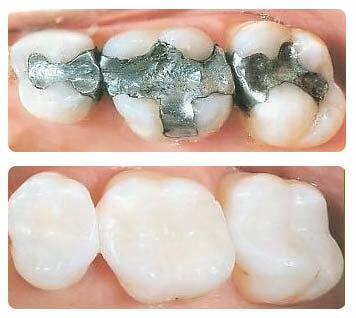
Metal vs. Composite
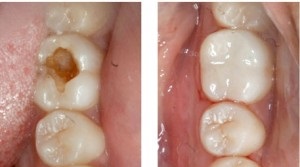
Cavity Before & After
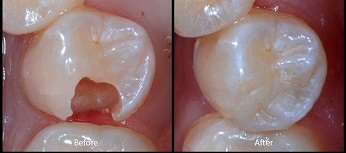
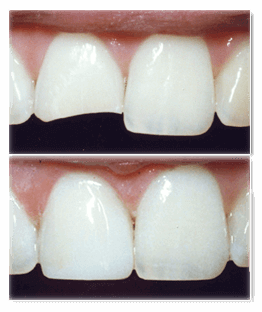
Composite Bonding
Typically Takes Just One Dental Visit
Cavity Procedure is
Relatively Simple and Painfree
- Step1 Local anesthetic is used to numb the area around the tooth to be filled
- Step2 The decay is removed
- Step3 The tooth & cavity is cleaned of bacteria and debris
- Step4 Cavity is filled with a composite tooth colored restorative material which is applied in layers
- Step5 A special light that “cures” or hardens each layer is applied.
- Step6 The composite material is shaped to the desired result
- Step7 Any excess material is trimmed off, and the final restoration is polished.
After Care:
- Follow good oral hygiene by brushing with a fluoride toothpaste, flossing and using an antibacterial mouthwash at least once daily
- Visit our Dental Office every 6 months for dental checkup and cleanings
FAQs
Most dental insurance cover the cost up to the price of the silver filling. The patient has to pay the difference in this case.
Tooth sensitivity to pressure, air, sweet foods, or temperature is fairly common. And the sensitivity typically resolves on its own within a few weeks. So you should avoid those things that are causing the sensitivity for the first few weeks. Please contact our Buford Dental Office if the sensitivity does not subside within two to four weeks or if your tooth is extremely sensitive. If you experience pain when you bite, the filling may be interfering with your bite. You will need to return to our dental office to have the filling reshaped.